
Written by our editorial team. Last updated: 9 September 2026.
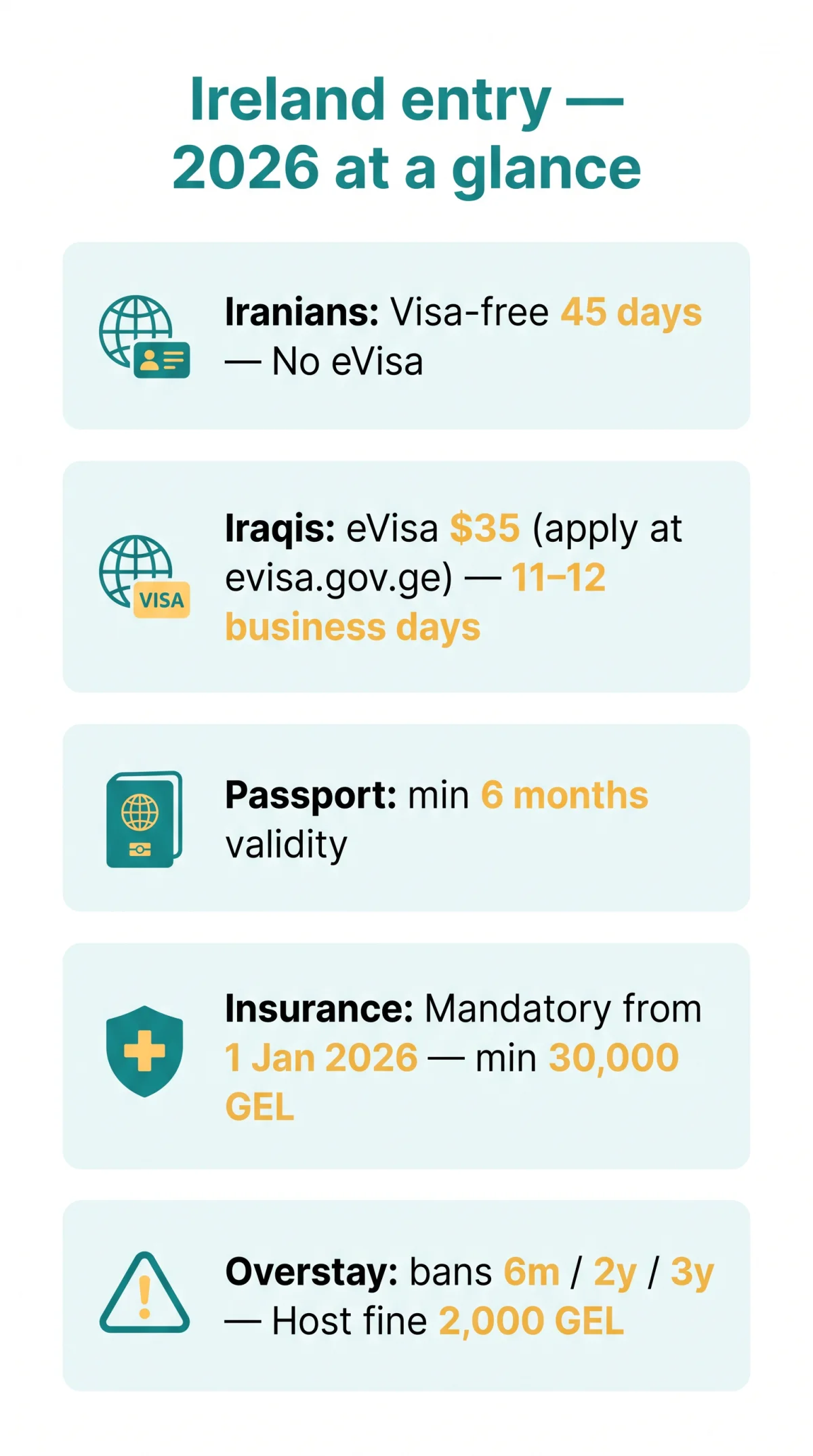
A Georgia evisa for Iranians is not required. Under a bilateral visa-waiver agreement, Iranian passport holders enter Georgia visa-free for up to 45 days. Iraqi citizens must obtain a Georgia eVisa online at evisa.gov.ge, paying $35 total ($20 government fee plus $15 DuVerify).
Both nationalities need a passport valid for at least six months beyond the planned entry date. From 1 January 2026, mandatory travel insurance with minimum coverage of 30,000 GEL applies to all visitors entering Georgia, including Iranian and Iraqi passport holders.
Border officers from the Ministry of Internal Affairs exercise wide discretion at entry points. According to IDFI data, Iranian citizens have historically faced high refusal rates, with 9,272 entry denials recorded in 2019, making thorough document preparation essential for both nationalities.
Iranian citizens do not need a Georgia eVisa. Under a bilateral agreement, Iranian passport holders may enter Georgia visa-free for up to 45 days with a passport valid for at least six months. Iraqi citizens, however, must apply for a Georgia eVisa online at evisa.gov.ge before travel.
Do Iranian Citizens Need a Georgia eVisa in 2026?
No. Iranian passport holders enter Georgia visa-free for up to 45 days under an indefinite bilateral visa-waiver agreement between Georgia and Iran. No pre-arrival registration, electronic travel authorisation, or Georgia eVisa for Iranians is required. Airlines and Georgian border police enforce a minimum passport validity of 6 months.
Why Iranians Don’t Use the eVisa Portal
The Georgia evisa for Iranians does not exist as a product on the evisa.gov.ge portal, which serves visa-required nationalities such as Iraqi citizens. Iranian travellers bypass the portal entirely. The Georgian Embassy in Iran references the eVisa system at iran.mfa.gov.ge/en/e-visa-portal, though access may be temporarily restricted.
| Requirement | Iranian citizens | Iraqi citizens |
|---|---|---|
| Visa requirement | Visa-free entry | eVisa required |
| Maximum stay | 45 days | 30 days |
| Application method | None | Online portal (evisa.gov.ge) |
| Total cost | $0 | $35 ($20 gov fee + $15 DuVerify) |
| Processing time | N/A | 11-12 business days |
| Minimum passport validity | 6 months | 6 months |
Georgia eVisa for Iraqi Passport Holders: Application and Fees
Iraqi passport holders must apply online before travel through evisa.gov.ge. Submit from outside Georgia; visa-on-arrival unavailable.
Gather required documents
Passport valid 6 months beyond entry date, digital photograph, confirmed hotel booking, recent bank statements, employer letter confirming position and salary, day-by-day itinerary, and confirmed return flight within the permitted stay.
Submit via the portal
Upload all scanned documents and complete the online form before fee payment.
Pay the fees
$20 government fee plus $15 DuVerify identity verification, totalling $35.
Await processing
The 30-day tourist visa takes 11-12 business days, with a 97% approval rate.
Receive the approved eVisa
Single entry only, valid 120 days from issue date, maximum stay 30 days.
Border Entry Requirements, Insurance, and Denial Risks for Iranians
Iranian tourists entering Georgia need: passport valid 6 months, return ticket within 45 days, accommodation proof (hotel or host invitation), financial proof (bank statements or cash), and a passport photo. Full entry guidance is available at geoconsul.gov.ge/en/entering-georgia.

Mandatory Travel Insurance (2026 Update)
Travel insurance with minimum 30,000 GEL coverage became legally compulsory for all visitors from 1 January 2026, not merely recommended. Coverage must include emergency outpatient and inpatient care. Iranian travellers should purchase insurance via an intermediary or pay cash due to international banking sanctions affecting card payments.
Cash Declaration Rules
Cash exceeding 30,000 GEL (~$11,000 USD) must be declared at the Georgian border. Non-declaration risks confiscation, essential for cash-dependent Iranians.
Flying In vs Driving In
IDFI data shows 434 Iranian denials in November 2018 alone, rising to 9,272 in full-year 2019. Higher refusal risk at Sadakhlo (Armenia), Red Bridge (Azerbaijan), Sarpi (Turkey) vs. Tbilisi/Kutaisi airports. No appeal process; in secondary inspection present: passport → ticket → hotel → insurance → bank statement.
Entering with a GCC Residency Permit
Holders of a valid GCC (Gulf Cooperation Council) multi-entry visa or residence permit may stay up to 90 days in any 180-day period, provided the permit is valid at entry. This applies to both Iranian and Iraqi citizens.
Georgia Overstay Rules – Bans, Fines, and Stay Extension
Overstaying triggers tiered re-entry bans from 6 months to 3 years for Iranian citizens and all other visitors, plus a 2,000 GEL fine for the host entity. Stricter penalties apply since October 2025. The tiered ban structure:
| Overstay Duration | Re-Entry Ban |
|---|---|
| Up to 3 months | 6 months |
| 3 months to 1 year | 2 years |
| Over 1 year | 3 years |
A Georgian host entity faces a fine of 2,000 GEL (~$744 USD) for a guest stay or work violation. Iranian citizens should set an alarm 3 days before the 45-day limit.
How to Extend Your Stay in Georgia
Iranian citizens can apply at a Public Service Hall (Justice House) in Tbilisi, Kutaisi, or Batumi before the current stay expires. Bring your passport, accommodation proof, financial proof, and a written justification for the extension. Approval is not guaranteed. For in-country consular assistance, the Iranian Consulate in Tbilisi is located at 8-80 K. Cholokashvili Ave, T’bilisi, Georgia; Tel: +995 32 2913660.
Frequently Asked Questions (FAQ)
Do Iranian citizens need a Georgia eVisa in 2026?
No. Iranians enter Georgia visa-free for up to 45 days under a bilateral visa-waiver agreement. No eVisa required.
Do Iraqi citizens need a Georgia eVisa in 2026?
Yes. Iraqi citizens must apply online at evisa.gov.ge. Total cost: $35 ($20 gov fee + $15 DuVerify). Processing: 11-12 business days.
How long can Iranians stay in Georgia without a visa?
Up to 45 days under the bilateral visa-waiver agreement. The 30-day figure refers to Georgia’s standard eVisa for visa-required nationalities.
What documents do I need at the Georgian border as an Iranian tourist?
Passport valid 6 months, return ticket within 45 days, hotel booking or host invitation, bank statements or cash, and mandatory travel insurance (30,000 GEL).
Is travel insurance mandatory for Georgia in 2026?
Yes. From 1 January 2026, travel insurance with minimum 30,000 GEL coverage is legally compulsory for all visitors, covering emergency outpatient and inpatient care.
What happens if I overstay my 45-day visa-free period?
Up to 3 months: 6-month ban. 3 months to 1 year: 2-year ban. Over 1 year: 3-year ban. Host entity fine: 2,000 GEL.
I’m an Iranian with a UK BRP or Schengen visa. Do I need a separate Georgian visa?
No. The bilateral visa-waiver applies regardless of UK BRP or Schengen visa. These do not grant extra border privileges or extend the 45-day limit.
What is the Georgia eVisa fee for Iraqi passport holders in 2026?
$35 total: $20 government fee plus $15 DuVerify identity verification, paid during the online application at evisa.gov.ge. Single entry, 30-day stay, 120-day validity.
Can I extend my stay in Georgia beyond 45 days?
Apply at a Public Service Hall (Justice House) in Tbilisi, Kutaisi, or Batumi before the 45-day visa-free period expires. Extension is not guaranteed.
How long does the Georgia eVisa take for Iraqi citizens?
11 to 12 business days for the 30-day tourist eVisa. Approval rate: 97%. Apply at evisa.gov.ge well in advance. Visa-on-arrival unavailable.
Can I enter Georgia through a land border as an Iranian citizen?
Yes, but land crossings (Sadakhlo, Red Bridge, Sarpi) carry higher refusal risk. Tbilisi and Kutaisi airports are lower-risk. Arriving by air is recommended.
Travelling to Georgia with minor children. What documents are required?
Notarised parental consent from both parents, translated into English or Georgian. Iran is not a Hague Apostille Convention signatory, so consular legalisation is required.
This article is based on publicly available government regulations and independent research by our editorial team. It does not constitute legal advice.